Plate IIThe demonstration
Eighty seconds
The whole game, drawn frame by frame. Every specimen in it is a real plate out of the collection, so the film cannot show a token that does not exist.
Plate IIIDetermination
Three facts
- i
A worker staked in the Hive draws 10,000 $HONEY a day.
- ii
Taking that honey costs 20% to the hornets. Every time.
- iii
Leaving the Hive with it is a coin flip. Half the time they take all of it.
Hornets draw nothing of their own. Every unit of honey a hornet has ever held was made by a worker.
Plate IVThe arithmetic
What the numbers actually do
Both columns start from the same staked worker and the same elapsed days. One of them draws every day. The other holds and tries to walk out.
Each acre adds 1% to a draw, capped at +50%. The bonus is added before the raid and before the coin flip, so the hornets tax it too.
| Drawn | 100,000 |
|---|---|
| Raided by the Nest | 20,000 |
| Kept, certain | 80,000 |
| Accrued | 100,000 |
|---|---|
| Lost if the flip goes wrong | 100,000 |
| Kept, on average | 50,000 |
Drawing pays 80%. Exiting pays 50%. That gap never closes, at any number of days, at any acreage. What it buys the hornets is not the 20%: it is that you keep coming back.
There is a floor to the damage, and it is worth knowing. The exit timer resets on every draw, so the coin flip only ever risks the honey earned since your last one. Leaving needs two days of it. Read it in Hive.sol, line 143.
Plate VApis
The workers
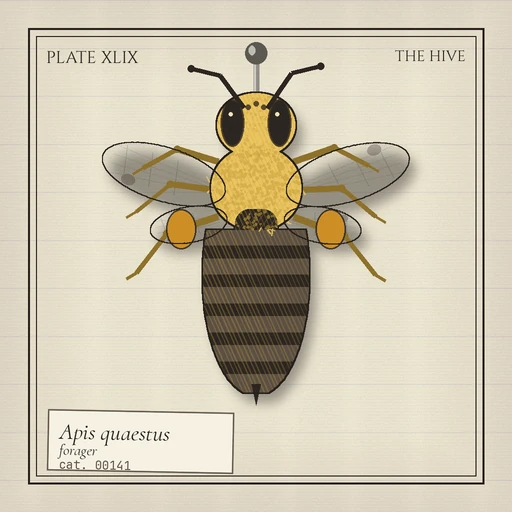
Nine in ten. They are the only thing in this system that makes anything.
What a worker does
Stake it in the Hive and it draws 10,000 $HONEY a day, forever, until the Hive runs dry at 2.4 billion. Unstaked, it does nothing at all.
Drawing resets its timer and pays the Nest a fifth. Leaving needs two days of honey and a coin that lands right.
What a worker carries
Pile, banding, abdomen, wing, eye and load, each rolled from the token's on-chain seed. The grail is Royal Jelly, four in a hundred.
A worker never carries a mandible. That field reads zero on chain, and the plate says forager.
Plate VIVespa
The nest
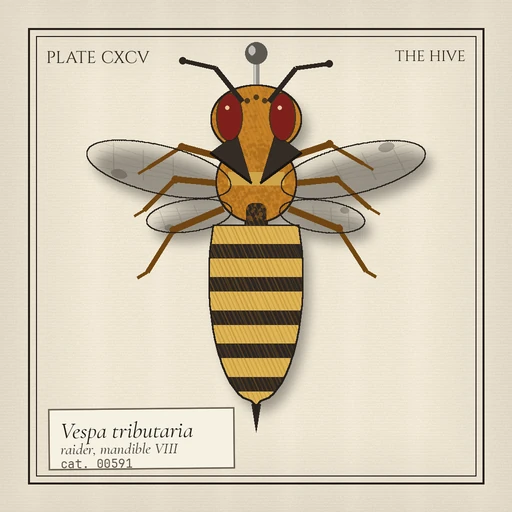
One in ten. A hornet has no yield of its own and never will. It is paid entirely out of what the workers make.
| Mandible | Odds at mint | Share weight | Expected count |
|---|---|---|---|
| VIII | 0.8% | 8 | 40 of 5,000 |
| VII | 15.7% | 7 | 785 |
| VI | 31.4% | 6 | 1,570 |
| V | 52.1% | 5 | 2,605 |
Staked hornets also take the Gen 1 steal: one in ten of every honey-bought mint is redirected to a hornet, weighted by mandible. An unstaked hornet gets none of this. The nest only pays those who sit in it.
Plate VIIThe brood
Gen 0 and the brood
Gen 0
Tokens 1 to 10,000, minted with ETH at 0.06942 each, ten to a transaction. Gen 0 is never stolen.
Species is rolled by commit and reveal: your payment and your token ids are locked first, and the roll comes later from a block you could not have known.
The brood, 10,001 upward
| 10,001 to 20,000 | 20,000 $HONEY |
|---|---|
| 20,001 to 40,000 | 40,000 $HONEY |
| 40,001 to 50,000 | 80,000 $HONEY |
All of it burned. And one mint in ten never reaches the wallet that paid for it: a staked hornet takes it instead.
Plate VIIIForage
The range
20,000 plots across 101 meadows. Half claimable free, one per Gen 0 specimen. Half sold by Dutch auction, gliding from 0.6942 ETH down to 0.1 over 6,942 minutes.
What acreage does
Every plot rolls 1 to 10 acres. Stake them and every draw made by the same wallet earns 1% more per acre, capped at half again.
What it does not do
The bonus is added before the raid and before the coin flip. The hornets tax it, and a robbed worker loses it with everything else.
The range makes a keeper richer. It never makes one safer.
Plate IXThe cabinet
The drawer
A sample of Gen 0, drawn by code from each token's seed. Every plate here can be regenerated from chain state by anyone, and must come out byte for byte the same.
Rendered at 512 pixels, shown small. Species and mandible come from the contract; everything else comes from the seed.
Plate XPreparation
How it is built
Four contracts
HONEY.sol
Colony.sol
Hive.sol
Range.sol
Solidity 0.8.30, OpenZeppelin 5.7. 84 tests across 8 suites, all passing. Unaudited.
The mint cannot be gamed
Species and mandible are rolled by commit and reveal. A commit that goes stale re-arms onto a fresh block rather than falling back to a value that is already public, which is the hole that sank the game this system is rebuilt from.
The art cannot drift
The chain stores species, mandible and a seed. Every visible trait derives from that seed by a published renderer, so the pictures can be reproduced by anyone and checked against the contract.